Ethical reliability — the capacity to consistently do what is right across contexts and over time — does not emerge automatically from ethical knowledge, good intentions, or strong values. It depends on the development of specific internal capacities, and on the organizational conditions that support them.
The NeuroCharacter Method addresses the first side of that equation: the individual.
Specifically, it answers a question that ethics training has largely left unanswered:
How do people become capable of reliably enacting the ethical commitments they already hold?
It asks about the development of character as a functional capacity: something you build, not something you receive.
What follows is an explanation of how that development works, and why it requires a different approach to ethics training than most organizations currently use.
The Problem with Most Ethics Programs
Most organizations approach ethics as an information problem. They invest in training that clarifies what is right. They publish codes of conduct that define expected behaviors. They run compliance programs that establish the rules. These efforts matter — you cannot act consistently with principles you have never understood.
But consider what they leave unaddressed.
They explain what integrity means. They do not develop the capacity to sustain it, particularly under pressure.
They clarify what fairness requires. They do not build the ability to perceive when fairness is at stake in the first place.
They articulate values. They do not create the motivational infrastructure that determines whether those values actually govern behavior when other incentives are pulling in the opposite direction.
The gap between ethical knowledge and ethical action — the knowledge-action gap — is one of the most thoroughly documented phenomena in moral psychology. It persists because the internal capacities that bridge that gap are not developed by information transfer alone.
Ethics is not learned the same way accounting is learned. Character is not a body of knowledge. It is a set of functional capacities that must be built through experience, practice, and progressive integration.
The NeuroCharacter Method was developed from this premise.
A Coordination Problem, Not a Knowledge Problem
When people fail to act in accordance with their own ethical commitments, the natural response is to assume something is missing: knowledge, motivation, willpower, or character. In some cases, those explanations are correct.
But a different explanation accounts for a much larger category of ethical failure: the kind that involves people who genuinely know what is right, genuinely care about it, and still do not do it.
What is missing in those cases is not any single capacity. It is their coordination.
Research across neuroscience, moral psychology, and virtue ethics converges on a common finding: reliable ethical action is not the output of a single mental faculty. It is an emergent property of multiple interacting systems that must perceive the ethical dimensions of a situation, assign those dimensions appropriate motivational weight, sustain commitment against competing pressures, and ultimately consolidate repeated ethical behavior into stable, automatic patterns.
When these systems work together, ethics becomes something a person can reliably do. When they are misaligned — when one operates effectively while others lag behind — ethical inconsistency follows. Not because the person lacks integrity, but because the architecture of their character has not yet achieved sufficient integration.
The NeuroCharacter Method calls this condition neurofunctional fragmentation.
Fragmentation is not a moral verdict. It is a developmental description. And like most developmental conditions, it can be addressed intentionally, systematically, and with lasting effect.
The Four Domains of Ethical Action
The NeuroCharacter Method identifies four neurofunctional domains that must operate in coordination for ethical behavior to be reliable. Each performs a distinct and necessary function. Each can be developed. And each, in isolation, is insufficient.
1. Attentional Salience
The capacity to perceive what is ethically at stake before deciding what to do about it.
Ethical action begins with ethical perception. Before any reasoning, deliberation, or choice can occur, a person must first recognize that a situation has ethical dimensions at all. This sounds obvious. In practice, however, it is where ethical failures most commonly begin.
Researchers call it ethical fading: the process by which the moral dimensions of a decision become cognitively invisible, backgrounded by the language of business problems, timing pressures, or competitive dynamics. The person making the decision is not lying to themselves. They are genuinely not seeing the ethical issue. Their attentional system has been trained by organizational culture, framing, and habit to notice some things and not others.
Developing attentional salience means training the capacity to see, to notice when an ethical consideration is present, even when the surrounding environment is not flagging it as such. Aristotle called this moral perception and treated it as a virtue in its own right. He was correct to do so. Without it, all subsequent ethical capacities are irrelevant.
2. Affective Valuation
The motivational weight that ethical commitments carry in the moment of decision.
Recognizing an ethical issue is not enough. What happens next depends on how much that recognition matters motivationally.
Antonio Damasio’s foundational research demonstrated that values without affective weight do not reliably guide behavior. His patients with damage to emotional processing regions of the brain could reason about ethics with full sophistication but they still made consistently poor real-world decisions. The moral principles were present. The motivational force behind them was not.
In organizational life, this plays out through a subtler mechanism. When institutions consistently reward competitive performance, rapid results, or social conformity, they are not simply incentivizing certain behaviors. They are shaping the affective architecture of the people who work within them. Over time, the felt urgency of ethical commitments diminishes relative to the felt urgency of performing. This is motivational misalignment and it is addressable.
Developing affective valuation means building genuine motivational investment in ethical commitments, not just intellectual endorsement. This requires experiential learning, narrative engagement, and the cultivation of professional identity around ethical values so that integrity becomes something a person feels compelled by, not just something they believe in.
3. Executive Regulation
The capacity to sustain ethical commitments under pressure, when it costs the individual something to do so.
This is where character is tested. You have perceived what is ethically at stake. You care about it. Now: can you act on it when a senior colleague pushes back, when the incentive structure points elsewhere, when you are exhausted from a difficult week, when you are facing emotional drama at home, when saying the right thing will cost you something?
Executive regulation is the functional capacity that bridges ethical intention and ethical action under conditions of friction. It involves the prefrontal systems of the brain that maintain goal representations across time, inhibit competing impulses, and keep moral commitments active when the environment is pushing against them.
Two things are worth understanding about this capacity. First, it is not unlimited. Under sustained cognitive and emotional demand, executive regulation degrades. Moral consistency is hardest to sustain precisely when the pressure is highest. People do not because people stop caring, but the regulatory resources available to act on what they care about have been depleted. Second, it is developable. Like a physical capacity, executive regulation strengthens through deliberate practice under demanding conditions, with structured recovery built in.
This is why ethical development cannot happen only in comfortable, reflective settings. The capacity to act ethically under pressure must be built under conditions that approximate that pressure.
4. Habit Formation
The consolidation of ethical behavior into stable, automatic patterns of character.
Habit formation is the destination of the developmental journey. This is perhaps the most important correction the NeuroCharacter Method offers to conventional thinking about character.
Aristotle was right that habituation is central to virtue. His insight is often misread as: practice virtuous actions until they become habits. The NeuroCharacter Method specifies what that means neurologically: the basal ganglia consolidate repeated action sequences into stable, procedurally available behavioral patterns triggered reliably by situational cues without requiring deliberate effort on each occasion. This is what stable character looks like. The honest response does not require a decision every time. It emerges as the natural response, the path of least resistance.
But the basal ganglia consolidate whatever is practiced. They do not evaluate whether what is being consolidated is good. If an executive has spent years navigating ethical pressures by rationalizing, deferring, or minimizing, those patterns will consolidate too and they will activate automatically in future high-stakes moments, before deliberate regulation has a chance to intervene.
This is why habit formation must come last in the developmental sequence. It consolidates the output of the three upstream domains. The quality of what gets consolidated depends entirely on what has been developed before.
Why Sequence Matters
The four domains do not develop independently or in parallel. They develop in a specific sequence that reflects both the neurological architecture of ethical action and the experiential logic of character formation.
Attentional salience must come first because it is the input gate of the entire system. If a person does not perceive the ethical dimensions of a situation, no other domain is activated. You cannot regulate what you do not notice. You cannot feel committed to addressing what you have not recognized as requiring attention.
Affective valuation must come second because executive regulation depends on it. You cannot sustain a commitment you do not feel motivated by. Developing regulatory capacity before motivational investment is in place produces self-control without moral direction.
Executive regulation comes third: building the bridge between caring and doing, specifically under the pressure and friction of real organizational life.
Habit formation comes last, consolidating the output of the first three into stable, reliable patterns of character that no longer require sustained deliberate effort.
The sequence reflects the logic of how ethical action actually works and why interventions that skip steps produce change that does not last.
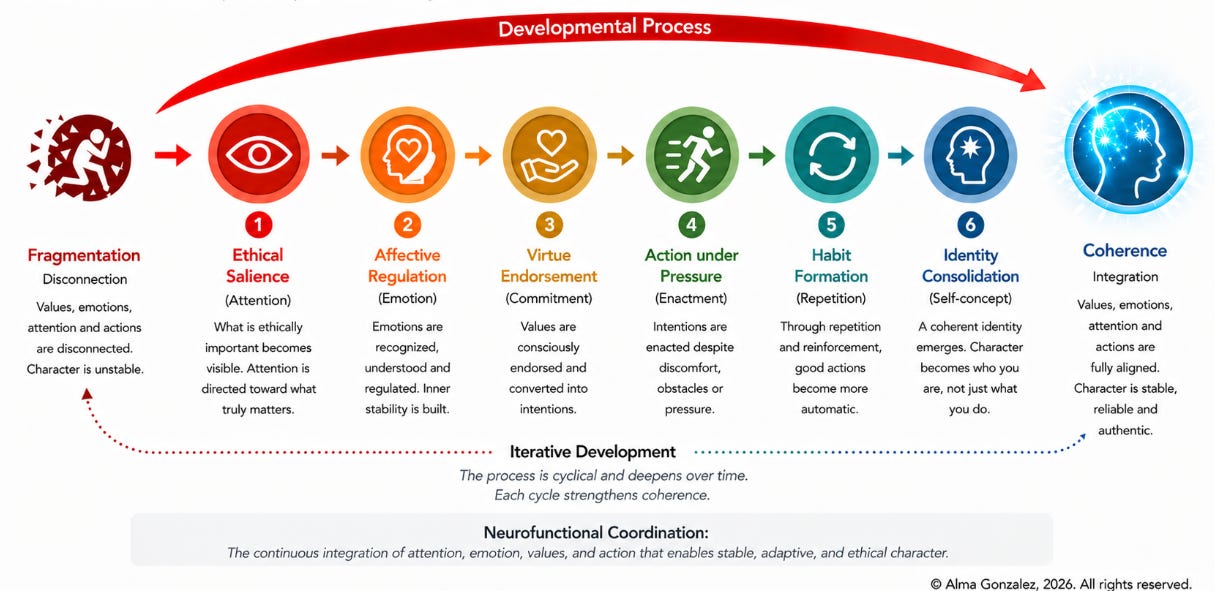
The Six-Stage Development Journey
The NeuroCharacter Method organizes the development of the four domains into six progressive stages:
Stage 1 — Ethical Salience
Developing moral perception: the capacity to notice what is ethically significant in everyday situations, including those that are ambiguous, fast-moving, or framed in non-ethical terms.
Stage 2 — Affective Regulation
Developing emotional awareness and regulation: learning to recognize the affective processes that drive behavior and bringing them into alignment with ethical commitments.
Stage 3 — Virtue Endorsement
The transition from externally held expectations to internally held commitments: values become personal, chosen, and self-defining rather than imposed.
Stage 4 — Action Under Pressure
Practicing enactment under conditions of genuine friction: uncertainty, competing incentives, social pressure, and personal cost. The domain of executive regulation is stress-tested here.
Stage 5 — Habit Formation
Consolidating repeated ethical action into stable behavioral patterns that require progressively less deliberate effort.
Stage 6 — Identity Consolidation
The final developmental achievement: ethical behavior is no longer experienced as something one consciously performs. It has become an expression of who one is.
The process is iterative. New organizational challenges, life transitions, or periods of sustained pressure can temporarily disrupt integration at any stage. Development continues throughout adulthood. The goal is not a fixed end state but progressive coherence increasing reliability over time.
What Neurofunctional Coherence Looks Like
The developmental goal of the NeuroCharacter™ Method is neurofunctional coherence: the state in which attentional salience, affective valuation, executive regulation, and habit formation operate as an integrated system in service of the same ethical commitments.
It is worth being precise about what this means.
Coherence is not moral perfection. A coherent individual still faces competing incentives, experiences pressure, and navigates ambiguity. The difference is that their response to those conditions does not require the same kind of exhausting deliberate effort that fragmentation demands. They notice the ethical dimensions of situations earlier. Their ethical values carry genuine motivational weight in the decision moment. Their regulatory capacity is more resilient under pressure. And their behavioral patterns are more reliably aligned with their values — not because their character has become more integrated.
But coherence is not permanent. It is a dynamic condition that responds to the demands placed on it. Sustained organizational pressure, chronic fatigue, or environments that structurally reward misaligned behavior can erode it. Deliberate practice, reflective learning, and supportive environments can rebuild and deepen it.
The question therefore is not whether someone has integrity. It is whether their internal architecture supports the consistent enactment of the integrity they possess.
This distinction is paramount for organizations. When ethical failures occur, the response is often to question character, to ask whether the person who failed had the right values. The NeuroCharacter™ Method asks a prior question: were the individual and organizational conditions that would have made reliable ethical action possible in place?
Why This Approach Is Different
The NeuroCharacter Method differs from conventional ethics and leadership development programs in three fundamental ways.
1. It develops functional capacities, not ethical knowledge. The content of ethics is not the primary object of development. The capacities that enable consistent ethical action are. This is a deliberate shift from information transfer to developmental practice.
2. It addresses the whole architecture, not isolated components. Most programs develop one dimension of ethical capacity: moral reasoning, emotional intelligence, or habit formation, while leaving others unaddressed. The NeuroCharacter™ Method targets all four domains and, crucially, the coordination among them. Isolated interventions produce isolated results. Integrated development produces integrated character.
3. It takes development seriously as a process, not an event. Character does not change in a workshop. It changes through sustained, sequenced practice that approximates the conditions under which ethical action will be required. The NeuroCharacter™ Method’s design principles follow from this: deliberate practice under increasing demand, structured reflection, iterative consolidation, and time.
The Bridge Between the Framework and Practice
The Ethical Reliability Framework explains the conditions under which ethical reliability emerges across individuals, organizations, and the systems that connect them. It identifies what must be in place for ethical behavior to become possible and predictable.
The NeuroCharacter™ Method provides the developmental pathway for building one side of that equation: the individual.
Understanding the framework tells you what to look for when ethical failures occur, and what conditions need to change. Applying the method tells you how to develop people who are capable of reliable ethical action.
Together, they offer something most ethics and leadership initiatives do not: a coherent account of why ethical inconsistency persists, and a principled approach to reducing it.
The defining challenge of ethical leadership is becoming the kind of person and building the kind of organization where doing what is right is reliable.
That is what ethical reliability means. And that is what the NeuroCharacter Method is designed to develop.